
2:25 pm
February 26, 2026
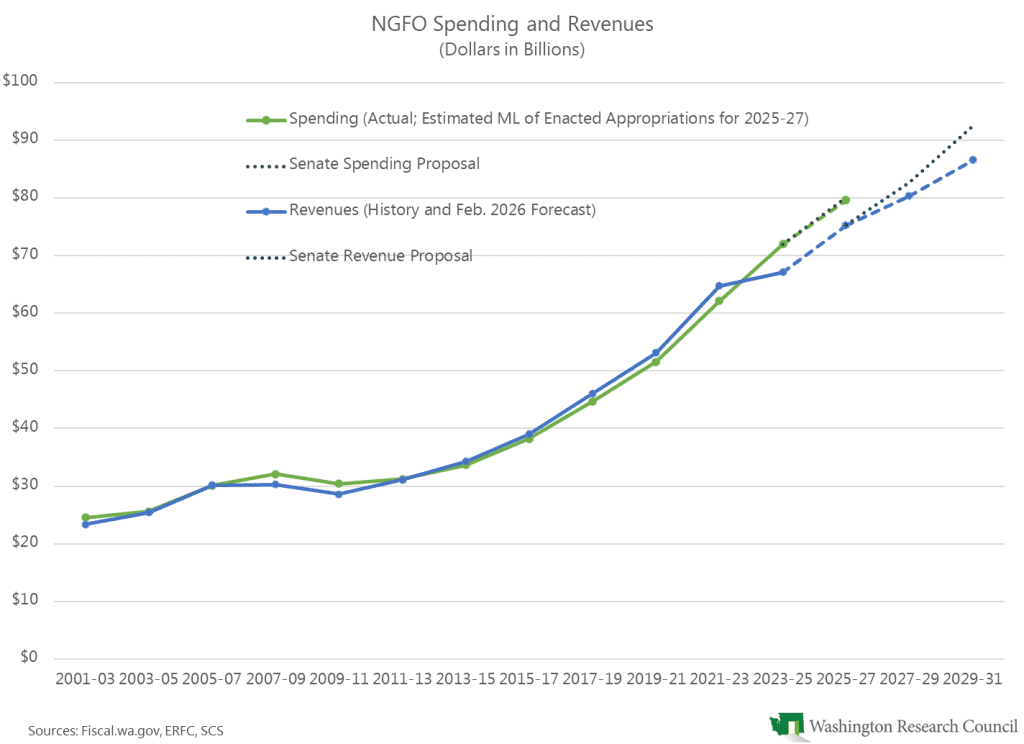
The cause of the state’s operating budget shortfall is, ultimately, that in 2023–25, the Legislature chose to spend $4.8 billion more than the state collected in revenues. (All figures in this post are in terms of funds subject to the outlook, or NGFO.) The budget balanced thanks to the use of one-time funds.
The budget adopted last year did not close that mismatch between spending and ongoing revenues, even as the Legislature increased taxes considerably. For 2025–27, enacted appropriations plus the current estimated maintenance level change (the cost of continuing current services, adjusted for inflation and enrollment) exceed revenues (as estimated in the Feb. 2026 forecast) by $4.3 billion.
The budgets proposed in the Senate and House this year would expand the difference between spending and revenues for 2025–27, to $4.8 billion and $4.6 billion, respectively.
Will the income tax save the day in 2027–29? Consider the Senate proposal: The estimated outlook indicates that continuing the proposed appropriations level into 2027–29 would increase spending by 2.2%. This should be considered a minimum. It doesn’t include, for example, new collective bargaining agreements with state and non-state employees for the biennium. Further, 2.2% biennial growth would be the lowest growth since 2009–11 (during the Great Recession). Average biennial spending growth from 2001–03 through 2025–27 was 10.6%.
With the proposed new taxes in the Senate proposal, biennial revenues would increase by 9.7% in 2027–29 and 12.0% in 2029–31. If spending is allowed to grow at the same pace, the difference between spending and revenues would grow to more than $5 billion in each biennium. If, instead, the state limited spending growth to 7% in each biennium (a low rate not seen since 2013–15), spending would exceed revenues by $3 billion in 2027–29 but revenues would just exceed spending in 2029–31.
If the Legislature doesn’t act to bring spending back in line with forecasted revenues, we will face shortfalls every year.
(For more on the supplemental proposals, see here.)
Categories: Budget , Tax Policy.Tags: 2026 supplemental