
1:11 pm
March 21, 2023
Gov. Inslee’s operating budget proposals were based on the November 2022 revenue forecast, but legislators will rely on the March forecast. As Kriss reported yesterday, compared to the November forecast, the March revenue forecast increased the estimated revenues for the current biennium, but decreased estimated revenues for the next two biennia. Altogether, over the budget window (2021–23, 2023–25, and 2025–27), the March forecast decreased revenues from funds subject to the outlook (NGFO) by $830 million—compared to the November forecast.
Compared to the February 2022 forecast, on which the current budget is based, the March forecast increased revenues by $3.106 billion over the same period.
In 2023–25, revenues are expected to increase by 2.4% over 2021–23. However, when you adjust for inflation, revenues are estimated to decrease by 4.1%.

Although revenues are higher than the Legislature anticipated last spring, costs have gone up as well. The costs of increased caseloads and inflation are incorporated in the estimated maintenance level for the budget. The estimated balance sheet below incorporates the new revenue forecast. For spending, it uses the maintenance level assumed by the governor in his budget proposals. It does not include any potential new policy spending. (The governor’s proposal would appropriate $4.854 billion for new policies.)
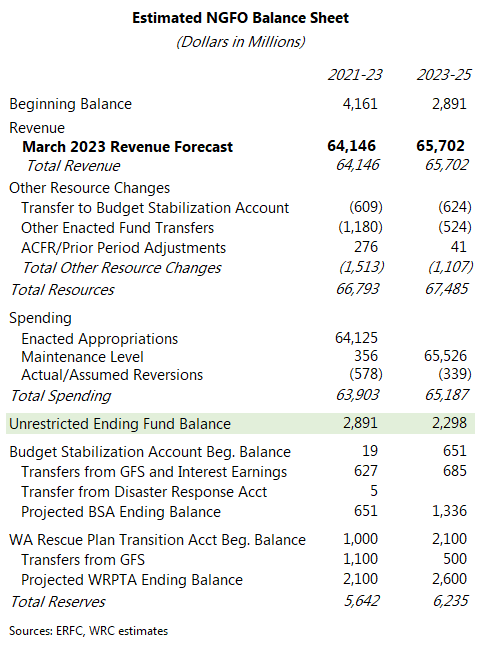
Clearly, the Legislature can, within current revenues, continue to fund current services. It could also fund current services even if the capital gains tax is ruled unconstitutional.
According to the Economic and Revenue Forecast Council, of the NGFO revenues in the March forecast, the capital gains tax accounts for $248 million in 2021–23, $942 million in 2023–25, and $1.069 billion in 2025–27.
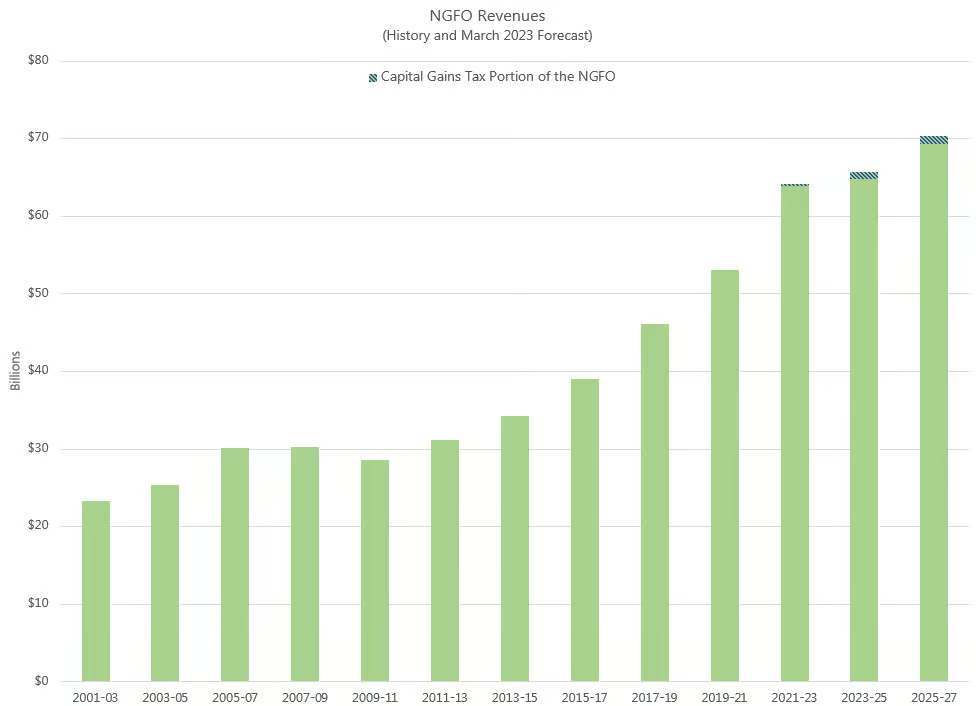
Yesterday Kriss noted the high level of uncertainty with this forecast, and wrote, “The appropriate response to this unusually large revenue uncertainty would be for legislators to write a budget that leaves an unusually large amount of money in reserve.” Nevertheless, Gov. Inslee’s proposal would drain the Washington rescue plan transition account (WRPTA, part of the state’s total reserves). At the very least, the Legislature should refrain from using reserves to fund new spending and it should make the extra $500 million deposit to reserves in 2023–25 that was assumed in the 2022 supplemental budget.
Categories: Budget , Tax Policy.Tags: 2023-25