2:27 pm
February 23, 2024
Appropriations from carbon emission allowance auctions are split among the operating, capital, and transportation budgets. A major thread connecting the three budgets this year is how to plan for the possibility that voters could approve I-2117 this fall. The initiative would repeal the climate commitment act, which would mean no auction proceeds to appropriate going forward.
State proceeds from the carbon emission allowance auctions totaled $1.825 billion in calendar year 2023. Of that, $857.1 million was collected in fiscal year 2023 (the final year of the 2021–23 biennium). The Dept. of Ecology’s Nov. 2023 forecast of the revenues estimated that they will total $2.578 billion in 2023–25. However, the December 2023 auction proceeds were $55.0 million higher than was assumed in the November forecast. Consequently, the available revenue over 2021–23 and 2023–25 is $3.490 billion.
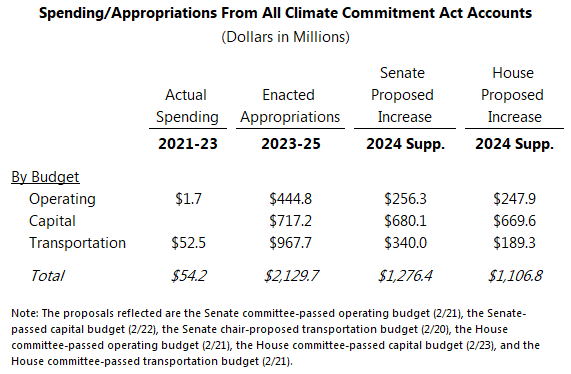
The Legislature appropriated $54.2 million from climate commitment act (CCA) funds in 2021–23. The enacted 2023–25 budgets appropriated $2.130 billion. Thus, the 2024 supplemental budgets could theoretically increase CCA appropriations by $1.306 billion for 2023–25. As the table shows, the Senate proposals would appropriate $169.6 million more than the House proposals. If adopted, the Senate proposals would bring total CCA appropriations (over 2021–23 and 2023–25) to $3.460 billion, just within available resources.
However, what if I-2117 passes? Ecology’s revenue forecast estimates that revenues for FY 2024 and the August 2024 auction (which would be during FY 2025 but before the election) would total $1.737 billion. Add in the actual FY 2023 revenues and the actual Dec. 2023 auction revenues, and the state is expected to collect $2.649 billion before November.
To stay within that estimated figure, both the Senate and House proposals specify that certain policies funded by the CCA would not be effective until Jan. 1, 2025; if the initiative passes, these appropriations would lapse.
Additionally, both the Senate and House would create a “consolidated climate account” and a “transportation carbon emissions reduction account,” to which they would transfer the balances of the current CCA accounts if I-2117 passes. These accounts would fund any unspent appropriations from the CCA accounts that take effect before Jan. 1, 2025.
However, in the House operating budget, some CCA appropriations would be effective before Jan. 1, 2025, but if I-2117 is passed, “funds from the consolidated climate account may not be used.” Presumably those appropriations could be spent until the initiative passes, but the Legislature would have to find another funding source after that.
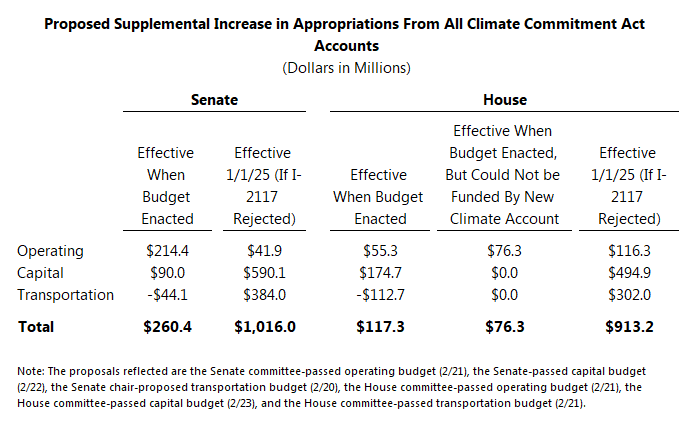
The table below shows how much of each proposal would be effective regardless of the initiative and how much would be affected by it. For example, if I-2117 is rejected, the Senate proposals would increase CCA appropriations by $1.276 billion, bringing actual spending in FY 2023 plus revised 2023–25 appropriations up to $3.460 billion. If I-2117 is approved, the Senate proposals would increase CCA appropriations by $260.4 million, bring the lifetime total up to $2.444 billion.
For more on enacted CCA spending, see this post.
Tags: 2024 supp