
1:12 pm
March 21, 2025
House Democrats released their tax proposals today. They include a financial intangibles (wealth) tax, business and occupation (B&O) tax surcharges, and an increase to the property tax growth limit. Altogether, House Democrats estimate that these proposals would increase revenues by $13.1 billion over four years. The estimated maintenance level shortfall is $8.7 billion.
The table below compares the revenue estimates to the tax proposals made by Senate Democrats yesterday. (Note that there are not full fiscal notes yet, so these numbers are estimates based on the general estimates provided in the press release.)
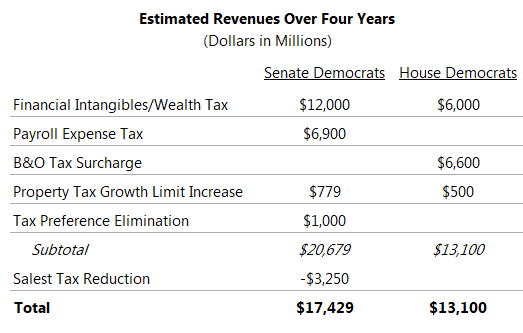
Each tax increase bill proposed yesterday and today would be among the largest state tax increases. (In the chart, the Senate proposals are in blue and the House proposals are in gray.)

The House wealth tax would be $8 per $1,000 of the value of the taxpayer’s taxable worldwide financial intangible assets, compared to $10 per $1,000 in the Senate proposal. The two proposals would both exempt the first $50 million. The House proposal would deposit revenues in the education legacy trust account (ELTA). The ELTA is a fund subject to the outlook; however, funds in the ELTA do not feed into the constitutionally-required deposits to the rainy day fund. Revenues from a wealth tax would be volatile and uncertain. For such taxes, it is especially important to set aside extra reserves.
The first proposed B&O surcharge would be 1% of taxable income over $250 million, excluding financial institutions that already pay a surcharge, manufacturers, and farmers. The second would be to increase the current 1.2% surcharge on certain financial institutions to 1.9%.
The property tax growth limit increase proposals from the House and Senate are quite different. Currently, property tax growth is limited to the lesser of 101% or 100% plus inflation. The Senate proposal would change it to the greater of 100% plus population change and inflation or 101%. The House proposal would change it to 100% plus population change and inflation, not to exceed 103%.
The House property tax proposal would also allow local governments to increase their growth limits to fund public safety programs. The Senate proposal would increase the school district enrichment levy limit, remove the special education funding enrollment cap, and require a work group to consider revisions to the school funding formula.
Categories: Budget , Tax Policy.Tags: 2025-27