
2:49 pm
January 6, 2026
As I wrote last month, Gov. Ferguson’s 2026 supplemental operating budget proposal would increase appropriations for 2025–27 from funds subject to the outlook (NGFO) by $1.159 billion. The maintenance level change (the cost of continuing current services, adjusted for caseloads and inflation) increases appropriations by $1.244 billion, but it is offset by net policy level reductions of $85.1 million. (All figures in this post are in terms of the NGFO unless otherwise noted.)
The policy level change is comprised of $1.330 billion in new spending and $1.415 billion in reductions. Of the reductions, $558.5 million are shifts from the NGFO to other accounts.
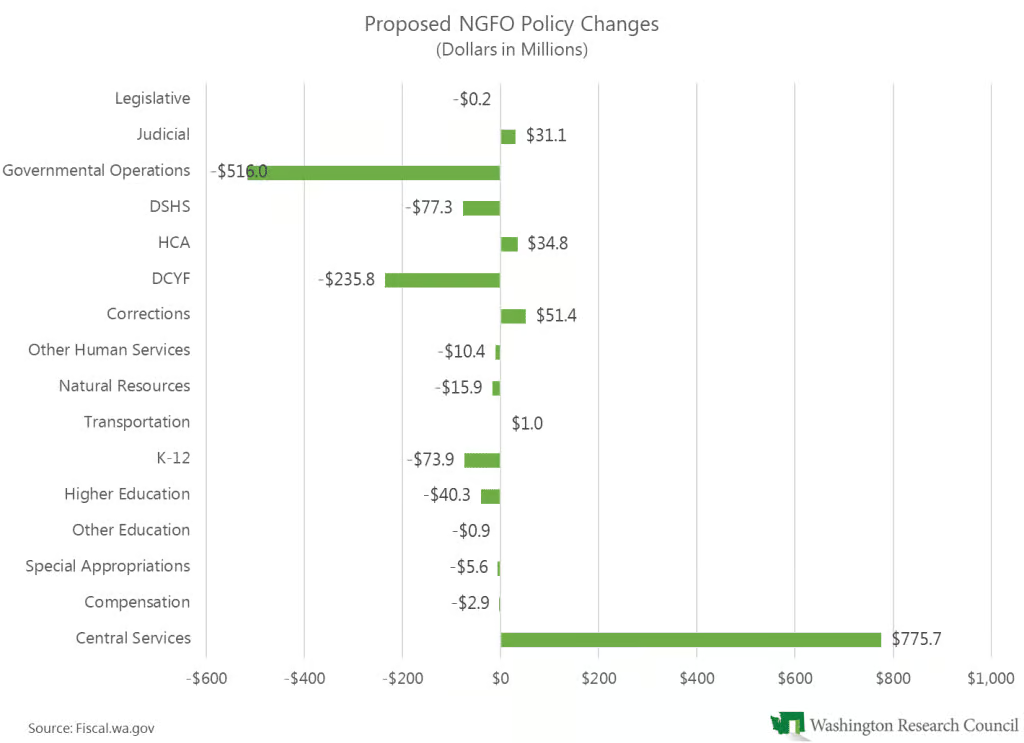
The chart shows the net policy changes by budget area. The largest increase is for central services. The state provides certain support services for all agencies (e.g., legal and auditing), and the agencies are charged fees for the services. The governor proposes increasing central service charges across all agencies by $775.7 million. This includes $681.8 million for the state liability account ($955.3 million from all funds). Before adopting the 2025–27 budget last year, the state knew that there was a major deficit in the account, but the biennial budget did not include a backfill. Now, according to the governor’s budget highlights document, the account “is facing a $1.3 billion–$1.4 billion shortfall this biennium.” Thus, the substantial proposed increase in funding would not fully solve the problem.
Additionally, of the central service changes, $83.6 million would help to fund the One Washington IT project.
Other major policy increases include:
- $71.0 million to restore savings assumed in the biennial budget from program integrity activities that were apparently “already captured in the agency’s base budget” (Health Care Authority).
- $26.5 million for close custody bed capacity at Monroe Correctional Complex (Corrections).
- $25.0 million for the state health care affordability account, which would be used to increase appropriations for the Cascade Care premium assistance program (Special Appropriations).
- $42.6 million for the Department of Children, Youth, and Families (DCYF) to pay eight settlement agreements that exceed the $10 million covered by the state liability account.
- $25.0 million for the Office of Refugee and Immigrant Assistance to continue expanded support services for individuals newly arriving to the U.S. (Department of Social and Health Services).
Major policy reductions include:
- $498.0 million at the Department of Revenue from shifting funding for the Working Families Tax Credit from the NGFO to the climate commitment account. (The overall funding for the program would also increase by $71.0 million at the policy level, but it’s not clear what the policy change is.)
- $217.5 million to limit the number of households in the Working Connections Child Care program to 33,000 (DCYF).
- $70.1 million from assuming that the federal disproportionate share hospital program will be delayed until FY 2028 (DSHS).
- $59.8 million due to a reduction in the Apple Health Expansion caseload (HCA). (It is not clear why this is not a maintenance level change.)
- $51.6 million in across-the-board and target reductions in higher education (5% for the Student Achievement Council; 3% for UW and WSU; and 1.5% for EWU, CWU, TESC, WWU, and the community and technical colleges).
- $48.6 million from delaying the nursing home rebase until FY 2028 (DSHS).
- $21.2 million from delaying the assisted living rebase until FY 2028 (DSHS).
- $41.1 million by rebasing the child care dual language rate to the 75th percentile of market instead of the 85th (DCYF).
- $34.6 million from assuming a federal waiver that would allow the state to delay implementing rules for paying providers prospectively and based on enrollment (DCYF).
- $29.1 million from reducing recent foundational public health services program expansions (Special Appropriations).
- $25.1 million by keeping the inflation enhancement for local effort assistance flat at $150 per pupil instead of the $250 funded in the biennial budget (K–12).
- $23.9 million in administrative reductions across agencies.
- $21.1 million from extending the assumed operating life of school buses (K–12).
Tags: Gov 2026