11:25 am
October 30, 2024
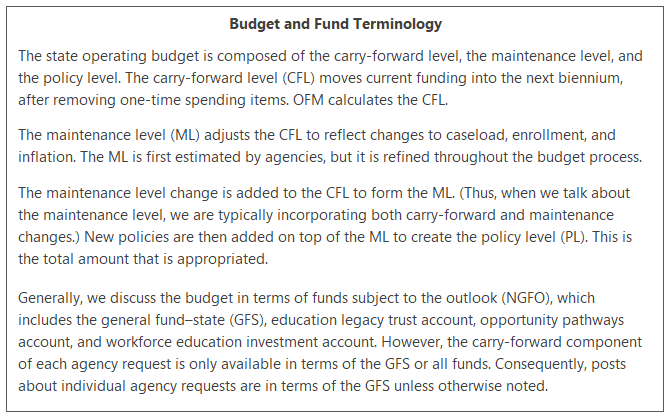
Our estimate of the 2025–27 budget shortfall is based on the projected cost of continuing to fund current services in the next biennium. That cost is comprised of carry-forward level changes, maintenance level changes, and the estimated cost of collective bargaining agreements (which are considered new policy but are highly likely to be approved by the Legislature). (See the box at the bottom of this post for budget and fund terminology.)
The carry-forward level changes were calculated by the Office of Financial Management (OFM), but the maintenance level changes come from agency budget requests. However, as we noted in our report and in a recent blog post, the maintenance level estimate is not set in stone—it will change over the course of the budget process. For example, OFM and the Legislature will evaluate the agencies’ maintenance level requests to determine whether any items should actually be classified as new policy. To the extent that spending requests are moved from the maintenance level to the policy level, it would reduce the size of the shortfall.
The 2025–27 budget request from the Department of Social and Health Services (DSHS) provides some examples of items that are included in the agency’s estimated maintenance level but do not belong there.
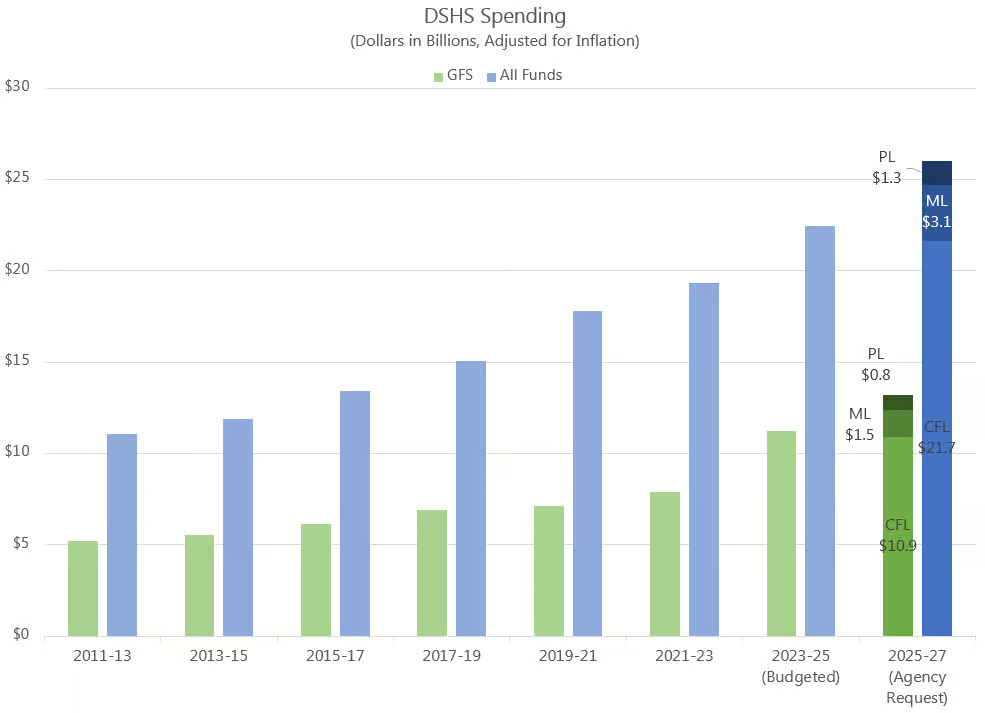
DSHS is requesting $13.209 billion from the general fund–state (GFS) for 2025–27. That would be an increase of $2.476 billion (23.1%) compared to enacted 2023–25 appropriations. Of the requested increase, $187.3 million is at the carry-forward level, $1.477 billion is at the maintenance level, and $811.3 million is at the policy level. (The request summaries are broken up into pieces: mental health, developmental disabilities, long-term care, Economic Services Administration, vocational rehabilitation, administration, Special Commitment Center, payments to other agencies, and information system services.)
Of the requested increase, 40.5% is for the Aging and Long-Term Supports Administration (ALTSA) and 36.5% is for the Economic Services Administration (ESA). ALTSA accounts for 48.7% of ML changes and ESA accounts for 66.3% of new policy.
For the maintenance level estimates, DSHS uses the June caseload forecast. Major maintenance level items include:
- $820.0 million in 2025–27 and $1.075 billion in 2027–29 for forecasted changes in caseloads, costs, and utilization for various programs.
- $71.5 million in 2025–27 and $80.7 million in 2027–29 to eliminate the assistance repayment requirement for Aged, Blind, or Disabled program participants. This is required by ESHB 1260 (enacted in 2023), but the funding was not included in the carry-forward.
Additionally, the maintenance level includes some clear examples of items that actually belong in the policy level, based on past state practice:
- $149.1 million in 2025–27 and $206.5 million in 2027–29 to adjust consumer directed employer (individual provider) rates. (The request notes that these numbers may not be final.)
- $31.4 million in 2025–27 and $43.9 million in 2027–29 to extend the individual provider rates to agency providers.
- $133.3 million in 2025–27 and $144.4 million in 2027–29 for the adult family home collective bargaining agreement. (Note that this item means we have a double count in our estimate of the shortfall, as this CBA is also included in OFM’s overall cost estimate for the CBAs.)
Major new policy spending requested by DSHS includes:
- $358.0 million in 2025–27 and $683.5 million in 2027–29 to set cash assistance grants at 15% of the need standard or the prior year’s grant standard (up to 3% annually), restore cash benefits to people who cannot work due to a health condition for at least 90 days, remove the 60-month limit on cash assistance, eliminate the WorkFirst policy that ends cash assistance for a whole family if an adult member of the household doesn’t meet work requirements, provide $2,000 to families whose cash assistance ends because they exceed income limits, and provide job retention services post-program.
- $75.3 million in 2025–27 and $74.9 million in 2027–29 to replace the state’s eligibility and enrollment system for safety net programs.
- $61.6 million in 2025–27 and $61.6 million in 2027–29 to support noncitizen migrants and asylum seekers.
- $45.8 million in 2025–27 and $48.8 million in 2027–29 to increase assisted living facility rates.
(Previous posts on 2025–27 agency requests are here. Our reports on the projected 2025–27 budget shortfall are here and here.)
Tags: 2025-27 , 2025-27 agency requests