
10:27 am
September 22, 2026
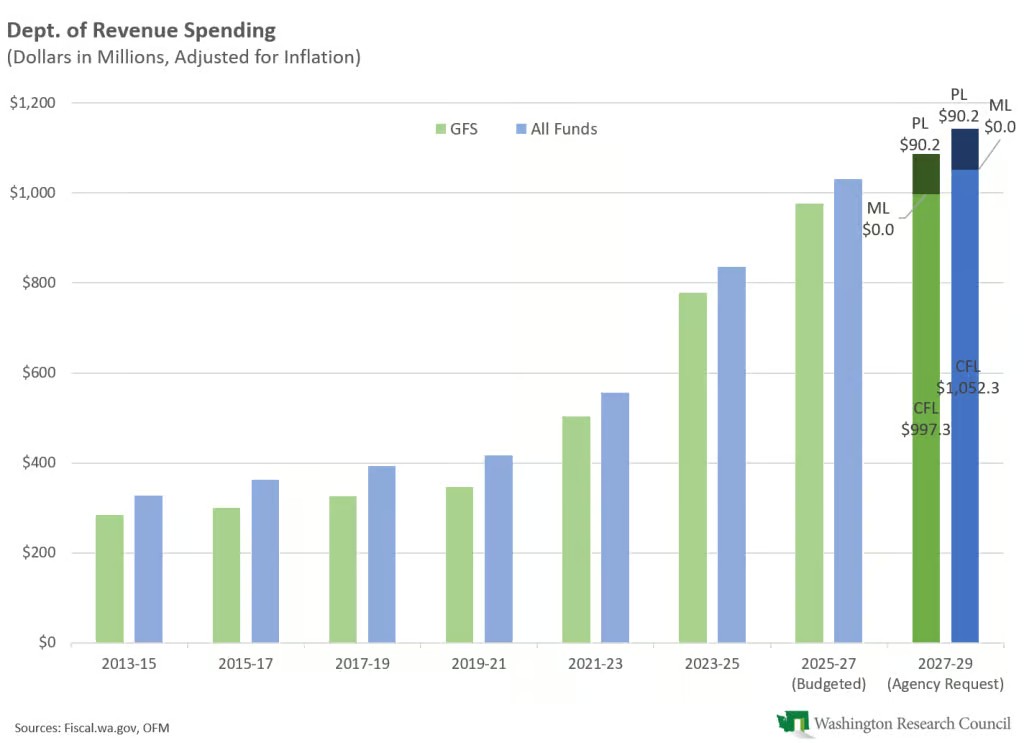
The Department of Revenue (DOR) is requesting $1.087 billion in general fund–state (GFS) appropriations for 2027–29, which would be an increase of $111.0 million (11.4%) over 2025–27 appropriations.
Of that increase, $20.8 million is at the carry-forward level. This includes $10.2 million for implementation of the state income tax. The budget request does not include any maintenance level changes.
Of the increase requested, a net of $90.2 million is categorized as new policy. This is mainly due to a request for $91.6 million to continue implementation of the income tax. (DOR also proposes $1.4 million in spending reductions.) The income tax request would cost $79.9 million in 2029–31.
The dollar amounts and estimates of full-time equivalent employees are about the same as estimated in the fiscal note for the income tax bill (ESSB 6346). Because the income tax bill was enacted this year, I wonder if these costs should be considered maintenance level, not new policy. Indeed, the official outlook for the enacted 2026 supplemental assumed costs related to both the implementation of the income tax bill and the bill’s expansion of the Working Families Tax Credit (WFTC) in 2027–29.
On that point, the budget request does not include any money related to the WFTC expansion: “Although not included in the amounts requested in this document, the agency will also require additional appropriations to fully fund the expanded Working Families Tax Credit program.” The request notes that WFTC remittances related to the income tax bill expansion are expected to cost $226.0 million in 2027–29 and $467.0 million in 2029–31. Those are the amounts estimated in the ESSB 6346 fiscal note; the caseload forecasts in November and next Spring could change the amounts.
In the chart below, the substantial increases in DOR spending beginning in 2021–23 are due to WFTC remittances. (Despite its name, the WFTC is structured as a spending program. Unfortunately, historical agency spending data lumps WFTC remittances in with other “tax administration services,” so it’s not possible to see exactly how much was spent each biennium.) The agency request numbers for 2027–29 are misleadingly low given that they don’t incorporate the WFTC remittance changes from the income tax bill. Including the estimated $226 million for the WFTC, the 2027–29 budget request would be $1.313 billion.
(Previous posts on the 2027–29 budget requests are available here.)

Tags: 2027 agency requests