
Based on Washington’s experience, a carbon tax probably wouldn’t pass by initiative in any state
In 2016 and 2018, Washington voters rejected ballot initiatives that would have imposed carbon taxes. (Here are our policy briefs on I-732 and I-1631.) The 2016 version aimed to be revenue neutral, while the 2018 version would have increased state revenues. Howard Gleckman of the Tax Policy Center points to a new study that considers […]
July 25 , 2019 - Emily Makings
In long-term care policy, Washington is out on its own
An article in Stateline today looks at options for paying for long-term care and includes a roundup of state activity on the topic. Of course, Washington adopted a public long-term care insurance program this year that will be funded with a payroll tax (we wrote about it in a recent policy brief). Other states are […]
July 17 , 2019 - Kriss Sjoblom
Seattle income tax headed to the state Supreme Court
In July 2017, the City of Seattle enacted a high earners income tax. The tax would apply only to residents of the city and not to people who work in the city but do not reside there. The amount of tax would be equal to 2.5 percent of annual income in excess of $250,000 for […]
July 12 , 2019 - WRC
New policy brief: Long-Term Care and Paid Family and Medical Leave: A Tale of Two Payroll Taxes
The Legislature has enacted two major payroll taxes in the last two years. Payroll taxes fund both a new long-term care insurance program that was enacted this year (the first in the nation) and the paid family and medical leave program that was adopted in 2017. The long-term care insurance premiums will be 0.58 percent […]
July 11 , 2019 - Emily Makings
A new national taxpayer roadmap shows how complicated tax administration can be
The Taxpayer Advocate Service has a new illustration of the U.S. tax system, in the style of a subway map. As it makes obvious, the tax system is complicated. As the press release notes, the map “shows why the road to tax compliance isn’t always easy to navigate.” And this is just the federal system. […]
July 01 , 2019 - Emily Makings
Happy Fiscal New Year!
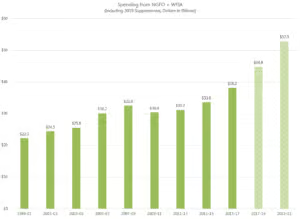
Today is the first day of fiscal year 2020 and the first day of the 2019–21 biennium. It’s a good time to review the biennial budget. The operating budget for 2019–21 (accounting for vetoes) appropriates $52.873 billion from funds subject to the outlook and the workforce education investment account. For more on the budget (as […]
June 27 , 2019 - Emily Makings
Running tally of 2019 revenue legislation, final edition
As Kriss noted earlier this week, the NGFO (funds subject to the outlook) revenue forecasts for 2019–21 and 2021–23 are up by $432.3 million and $677.5 million, respectively. The bulk of those increases ($329.8 million and $604.6 million) are due to legislative changes made during the 2019 session. I’ve made a few updates to our […]
June 26 , 2019 - Emily Makings
ERFC will forecast revenues from the new workforce education investment B&O surcharge
Following adoption of the June revenue forecast yesterday (Kriss’s report on the forecast is here), the Economic and Revenue Forecast Council (ERFC) discussed including in the forecast revenues from the business and occupation tax surcharge for workforce education that was enacted this year (E2SHB 2158). Sen. Rolfes raised the question, saying, “I believe it would […]
June 13 , 2019 - Emily Makings
Running tally of 2019 revenue legislation, 5th edition
[UPDATE 6/27/2019: An updated version of the table is available here.] I’ve updated our table showing the revenue impacts of tax bills passed by the Legislature this year. It incorporates new information from updated fiscal notes and from the official outlook adopted by the Economic and Revenue Forecast Council earlier this week. Note that although […]
June 07 , 2019 - Emily Makings
Not all states have regained pre-recession spending and revenue levels
In a new report, Pew provides data on how state finances have recovered (or not) from the Great Recession. As we showed in a pair of December reports, Washington’s spending and revenues are higher than their pre-recession peaks. But that’s not the case for all states. Of the Pew report, Opportunity Washington writes, If rising […]