10:00 am
February 2, 2023
SB 5099 would deposit “extraordinary” estate tax revenues into the developmental disabilities community services account (DDCSA) instead of the education legacy trust account (ELTA).
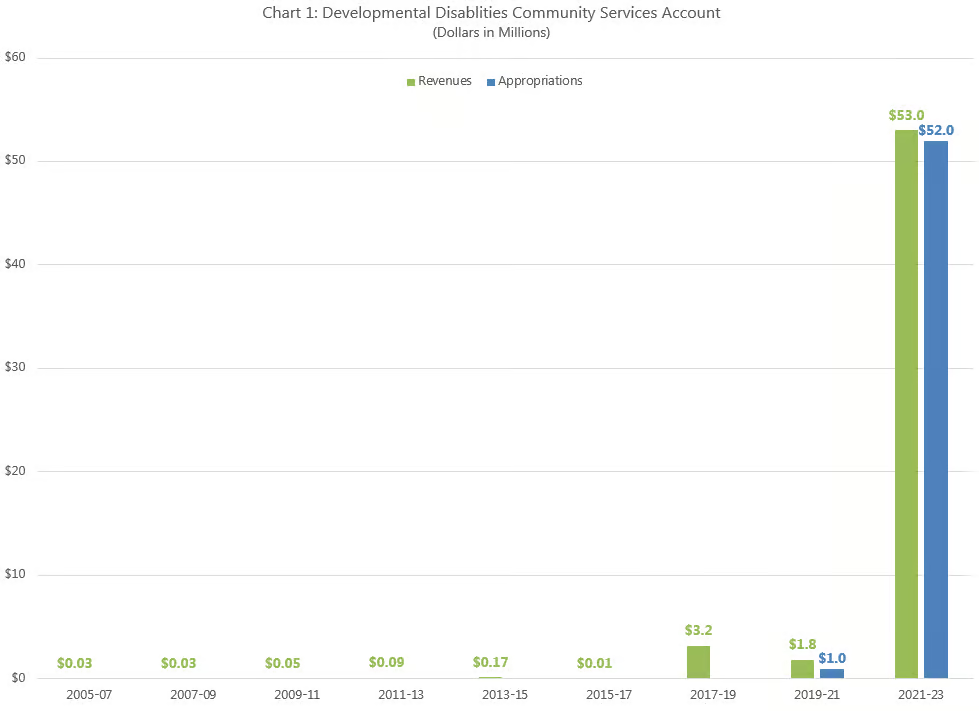
The DDCSA was created in 2005 and may be used for “supports and services in a community setting to benefit eligible persons with intellectual and developmental disabilities.” It is currently funded with “proceeds from leases or sales of real property, conservation easements, and sales of timber, from the state properties at the Fircrest residential habilitation center, the Lakeland Village residential habilitation center, the Rainier school, and the Yakima Valley school.”
However, those proceeds have been fairly small, as shown in chart 1. In 2021, as part of the 2021–23 biennial budget, the Legislature appropriated $50.0 million from the general fund–state to the DDCSA. Budget documents noted that these funds were one-time and were offset by the enhanced federal Medicaid home and community-based services match that was received during the pandemic. The funds were “reinvested one-time in community services for those with intellectual and developmental disabilities.” (Gov. Inslee’s 2023 supplemental budget proposal would reduce the 2021–23 DDCSA appropriation to $16.6 million. His 2023–25 budget proposal would then appropriate $37.4 million from the account, mostly to continue funding home and community-based services for individuals with intellectual and developmental disabilities.)
SB 5099 notes that “a lack of reliable revenue sources has proven to be a barrier to achieving” the goal of supporting independent living.
Meanwhile, Washington’s stand-alone state estate tax has been in place since 2005. (A previous version was tied to the federal estate tax.) The tax rate ranges from 10% to 20%, depending on the value of the estate. There is currently a $2.2 million exclusion. Estate tax collections are deposited in the education legacy trust account (ELTA), which is a fund subject to the outlook (NGFO).
Annual estate tax revenues had been under $200 million until fiscal year 2018. Since then, they have trended up and are forecasted to continue growing. There are two years in which revenues appear to be “extraordinary”—that is, they are significantly higher than the trend: In 2020, collections totaled $646.3 million and in 2023, collections are expected to reach $564.9 million (given unexpectedly high collections through October). In 2027, estate tax revenues are estimated to be $413.1 million. (See chart 2.)

SB 5099 would transfer half of any annual estate tax collections over $400.0 million to the DDCSA instead of the ELTA. According to the fiscal note, this would reduce revenues to the ELTA (and consequently to the NGFO) by $6.6 million in 2025–27 and $30.8 million in 2027–29. If this policy was already in place, the transfer to the DDCSA would have been $123.1 million in 2020 and an estimated $82.5 million in 2023.
The Senate Ways & Means Committee was scheduled to act on SB 5099 on Jan. 31, but the bill was pulled from consideration for more discussion. Sen. Braun had proposed an amendment that would increase the transfer threshold to $500.0 million. At $500.0 million, there would probably not be an NGFO impact in 2023–25, 2025–27, or 2027–29.
The threshold in the bill isn’t indexed to inflation. Although there would be a very minimal impact to the NGFO in the near term if the bill is enacted, there would be more and more transfers of “ordinary” estate tax revenue out of the ELTA over time, especially at the $400.0 million threshold.
Categories: Budget , Tax Policy.