
9:06 am
June 26, 2025
The Transportation Economic and Revenue Forecast Council now estimates that transportation revenues will be higher than assumed in the enacted 2025–27 transportation budget. (By contrast, revenues from funds subject to the outlook are expected to be lower than assumed in the 2025–27 operating budget.) Economic changes in the transportation revenue forecast are estimated to increase revenues by $11 million (0.2%) in 2023–25, $116 million (1.6%) in 2025–27, and $153 million (2.1%) in 2027–29.
Traditionally, the transportation revenue forecast has included revenues from motor vehicle fuel taxes (the largest source of transportation revenues); vehicle and driver fees; ferries; tolls; the vehicle sales and use tax; the rental car tax; and various other transportation-related sources. The June revenue forecast also includes the Climate Commitment Act (CCA) revenues from the carbon emission allowance auctions that are dedicated to the transportation budget and other transfers, to better reflect all revenue available to transportation budget writers.
In addition, the June forecast incorporates the new revenues related to the transportation revenue package that was adopted this year, which increases various transportation taxes and fees (including a gas tax increase).

All told, the June forecast estimates that transportation revenues will total $8.093 billion in 2023–25, $8.950 billion in 2025–27, and $10.978 billion in 2027–29. That is not directly comparable to the March forecast, as it includes the CCA revenues and other transfers that were previously part of the transportation budget but not shown in the forecast.
Excluding those items, the June forecast estimates that transportation revenues will increase compared to March by $11.0 million (0.2%) in 2023–25, $864.0 million (12.2%) in 2025–27, and $1.915 billion (26.4%) in 2027–29. As noted above, only a small portion of that is due to economic changes; most of it is due to the revenue changes made by the Legislature this year.
Gas consumption is expected to be higher than in the March forecast. At the same time, revenues from electric vehicle (EV) fees are expected to be slightly lower than in the March forecast. Over the ten-year forecast window, however, gas consumption is expected to continue to decline, and EV fees are expected to make up a growing share of combined revenues from EV fees and the motor vehicle fuel tax. (The EV share was 2.6% in 2024 and is estimated to be 12.1% in 2035.)
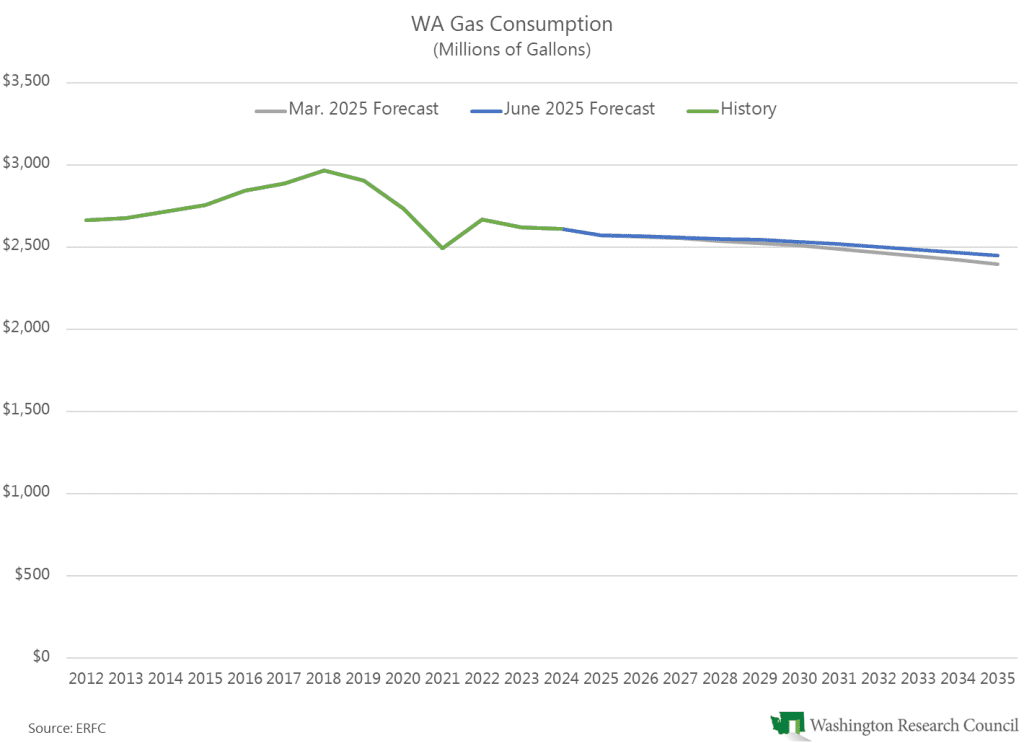
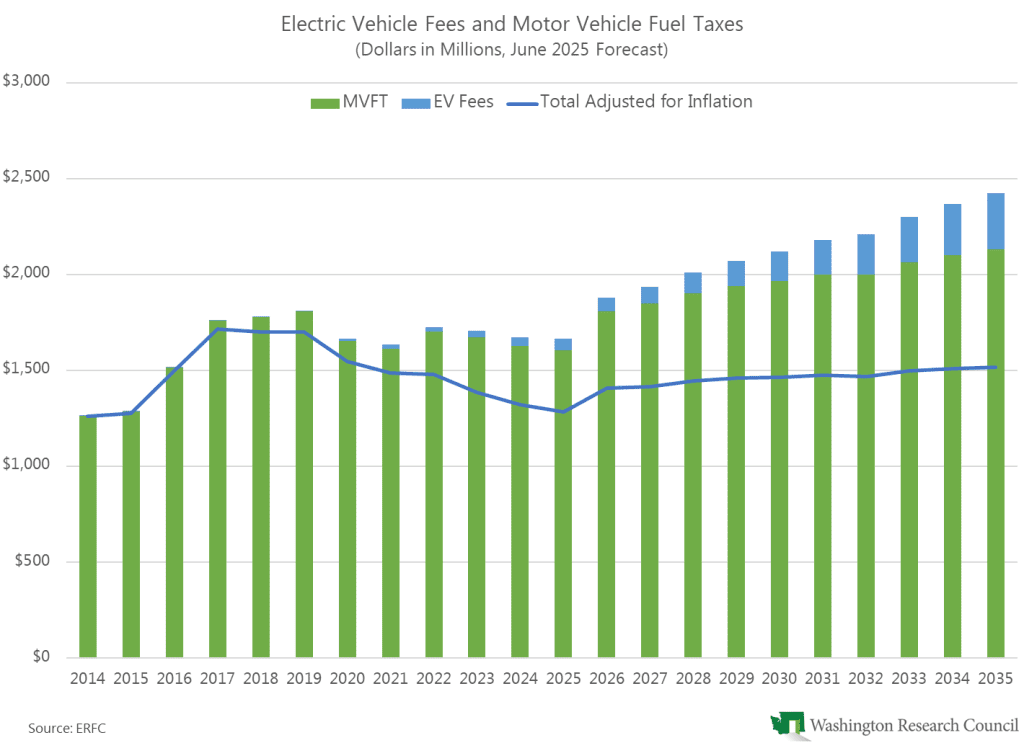
As we’ve written, the transportation budget has long-term funding challenges. The March revenue forecast estimated that forecasted transportation revenues (adjusted for inflation) would decline by 11.5% from 2024 to 2035. With the new revenue package, inflation-adjusted forecasted transportation revenues (excluding the CCA funds and transfers) are expected to increase by 18.2% from 2024 to 2035. However, inflation-adjusted revenues are estimated to begin decreasing in 2030. From 2029 to 2035, revenues are expected to decrease by 1.2%. (Compare that to a 6.9% decrease from 2029 to 2035 in the March forecast.)
Categories: Budget , Transportation.