
2:23 pm
November 28, 2017
On Friday, the Seattle Times editorial board wrote about six education reforms it believes are needed: improve graduation rates, close the achievement gap, build classrooms, “fully embrace early learning,” maintain college funding, and “fix unintended consequences.” While recommending reforms, the editorial board also acknowledges the recent Supreme Court order in the McCleary case: “In the upcoming 60-day legislative session, the challenge is to fund an additional $1 billion by the fall 2018 deadline they set themselves.”
Opportunity Washington has more on that challenge. Additionally, I thought a few of the recommendations could use a little context:
Classroom construction. According to the editorial,
Some lawmakers question whether school building costs are part of the basic education mandates in the McCleary rulings. That’s a distraction. School districts need more classroom space to offer all-day kindergarten and to decrease teacher-student ratios in the early grades — ordered by the Supreme Court.
That first sentence is perplexing given that the Court’s Nov. 15 order explicitly states that construction is a shared responsibility of the state and local districts and is not part of basic education:
Plaintiffs additionally urge that the State has not accounted for the capital costs of additional class space needed for all-day kindergarten . . . . But in McCleary, this court did not address capital costs or suggest that capital expenditures are a component of basic education for purposes of article IX, section 1, such that the State must fully fund capital costs attendant to the basic education program. Though classroom space is obviously needed to maintain all-day kindergarten and reduced class sizes, capital costs have never been part of the prototypical school allocation model, and it is not solely a state obligation under the constitution. [p. 31]
Additionally,
In disputing that the State has fully funded class size reductions, plaintiffs again focus on capital expenditures for the necessary additional space. But as discussed, the State is correct that full state funding of school capital costs is not part of the program of basic education constitutionally required by article IX, section 1. [p. 33]
(I wrote about the order in depth here.) The editorial board urges the Legislature to pass a capital budget and to amend the state constitution so that school bond issues require just a simple majority to pass, rather than 60 percent. (To amend the state constitution, two-thirds of the House and Senate, as well as a majority of voters, must approve.)
If the 60 percent threshold for approval of school bonds were dropped, it would significantly increase the number of bonds that are approved. Many bond issues win simple majority approval but fail because they don’t meet the 60 percent threshold. For example, in 2015, 54.8 percent of bond issues were approved by voters. If only 50 percent approval had been required, 85.7 percent of bond issues would have been approved.

College funding. The editorial says, “during the last recession the Legislature used higher education as the state’s rainy day fund. . . . That was the wrong approach and should not be repeated.” It’s certainly true that higher education spending was cut significantly in response to the recession.
The state budget includes many programs that cannot be cut due to constitutional or federal mandates. Higher education is one of the largest (in terms of state dollars) budget areas that is discretionary. As this chart from a 2014 policy brief shows, higher education spending was cut by $479.3 million from 2007–09 to 2013–15.
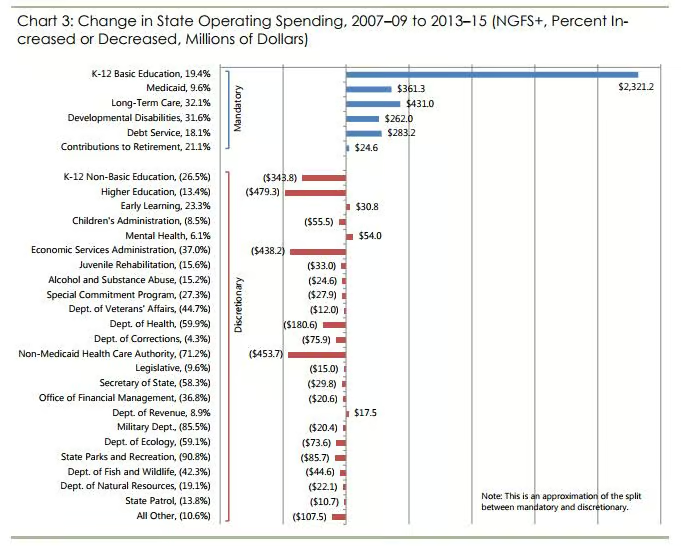
In 2014, the Office of Financial Management estimated that about two-thirds of the state budget was protected. Since then, the Legislature has increased K–12 spending so that it accounts for more than 50 percent of the budget; because K–12 spending is largely (but not entirely) protected, more than two-thirds of the budget is probably protected now.
Categories: Budget , Categories , Education.