12:23 pm
September 25, 2025
The 2026 supplemental operating budget request from the Department of Social and Health Services (DSHS) includes increased state funding in response to the Medicaid and Supplemental Nutrition Assistance Program (SNAP) changes made by the federal government in H.R. 1. (The Health Care Authority is the main administrator of Medicaid in Washington, but DSHS also receives significant Medicaid funding, mainly for its long-term care and developmental disabilities programs.)
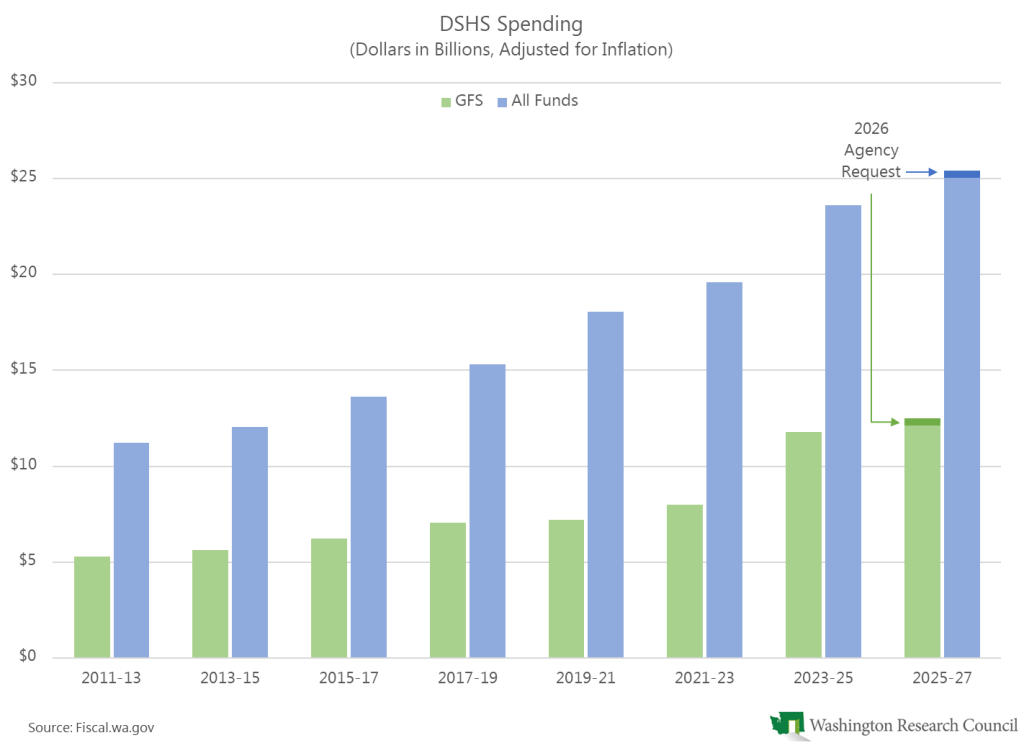
The enacted 2025–27 operating budget appropriates $12.126 billion from the general fund–state (GFS) for DSHS. For the 2026 supplemental budget, DSHS is requesting an additional $378.6 million (3.1%) from the GFS for the biennium. The additional spending would grow to $833.6 million in 2027–29.
(The request summaries are broken up into pieces: mental health, developmental disabilities, long-term care, Economic Services Administration, vocational rehabilitation, administration, Special Commitment Center, payments to other agencies, and information system services.)
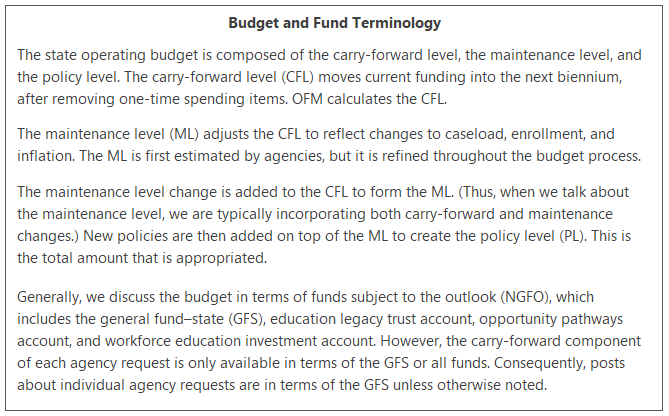
Of the total request, DSHS categorizes $317.2 million in 2025–27 and $732.8 million in 2027–29 as maintenance level (the cost of continuing current services, adjusted for caseload and inflation). However, this includes a substantial amount that should probably be classified as policy level. (See the box below for more on how the maintenance level is determined.)
One aspect of DSHS’s request that is correctly categorized as maintenance level is the estimated changes related to caseloads and utilization. DSHS uses the June caseload forecast to estimate these figures. (The governor’s budget proposal will use the November caseload forecast.) Altogether, caseload and utilization changes for DSHS are estimated to reduce spending by $25.9 million in 2025–27 and by $18.8 million in 2027–29.
DSHS is requesting $156.3 million in 2025–27 and $594.2 million in 2027–29 (classified as maintenance level) for costs related to H.R. 1. The H.R. 1-related requests are:
- $1.1 million in 2025–27 and $337.3 million in 2027–29 to contribute to the cost of SNAP benefits based on Washington’s payment error rate. H.R. 1 requires states to pay for up to 15% of SNAP benefits (beginning Oct. 1, 2027) if their payment error rates are at least 6%. Washington’s error rate was 6.06% in federal fiscal year (FFY) 2024 and is about 9% in FFY 2025. The request assumes that Washington will have to contribute 10% of SNAP benefits in FFY 2028 and FFY 2029. The $1.1 million in 2025–27 would be used to increase case review and oversight in order to reduce the error rate.
- $49.5 million in 2025–27 and $131.9 million in 2027–29 to fund increased state responsibility for administrative costs in SNAP. Currently the state pays half the administrative costs and the federal government pays the other half. Under H.R. 1, beginning Oct. 1, 2026, the state will be responsible for 75%.
- $126.3 million in 2025–27 and $163.9 million in 2027–29 to fund increases to the state’s Food Assistance Program (FAP) caseload due to new SNAP eligibility restrictions for certain immigrant groups. The FAP is a state program for legal immigrants and victims of human trafficking. Statute requires the rules for the program to “follow exactly the rules of the federal food stamp program except for the provisions pertaining to immigrant status.” According to DSHS, about 30,000 Washingtonians will no longer be eligible for SNAP under H.R. 1, and the request assumes that they will move to FAP.
- Savings of $4.0 million in 2025–27 and $6.2 million in 2027–29 in the FAP. H.R. 1 changes SNAP eligibility so that payments from the low-income home energy assessment program count as income. According to DSHS, this will reduce benefits for some FAP clients by an average of $82.60 a month.
- Savings of $19.1 million in 2025–27 and $32.7 million in 2027–29 due to estimated lower caseloads in FAP as a result of new federal work requirements for SNAP.
- A placeholder related to the new federal SNAP work requirements: DSHS wants additional resources to help people newly subject to the work requirements maintain benefits.
Other notable requests include:
- $68.7 million in 2025–27 and $68.7 million in 2027–29 to backfill the expected loss of federal funding for the disproportionate share hospital (DSH) program. As I’ve written, the federal government has planned for years to reduce DSH allotments to states, but it has also acted to delay the reductions numerous times. Under current law, the allotment reductions are scheduled to begin Oct. 1. The enacted 2025–27 budget assumed that the reductions would be delayed again and consequently booked one-time savings of $68.7 million. (The request considers this maintenance level, but previous budgets classified the savings as policy level.)
- $39.4 million in 2025–27 and $38.9 million in 2027–29 to change the direct care staff relief factor for the state psychiatric hospitals.
- $304,000 in 2025–27 and $32.1 million in 2027–29 to fund the final version of SB 5393. Originally the bill would have closed Rainier School by June 30, 2027, but the enacted version ends all new admissions to the school on that day.
- $25.0 million in 2025–27 and $50.0 million in 2027–29 to support noncitizen migrants and asylum-seekers. The state appropriated $25 million in FY 25 and $25 million in FY 2026 for this purpose.
(Previous posts on the 2026 supplemental budget requests are available here.)
Tags: 2026 agency requests