12:48 pm
June 12, 2025
The Seattle Times reports, “As Washington grapples with a multibillion-dollar budget shortfall, some state agencies are starting the largest wave of layoffs since the Great Recession.”
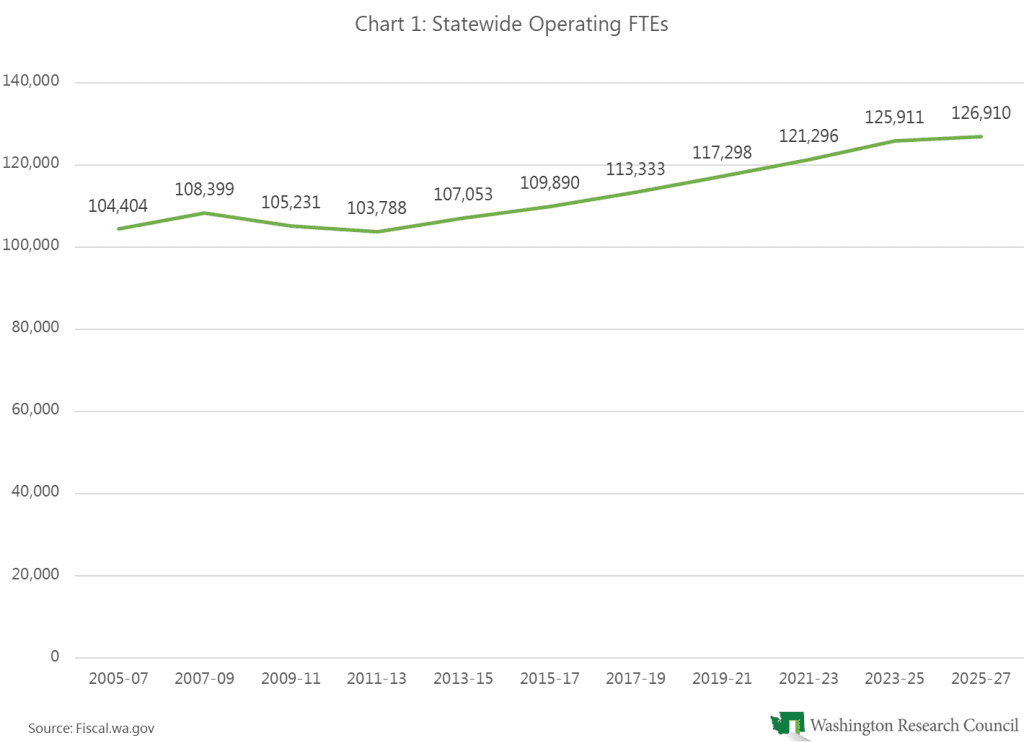
For context, Chart 1 shows total state full-time equivalent (FTE) employees over time. The budgets passed by the Legislature for 2025–27 increase FTEs compared to 2023–25, whereas FTEs decreased in 2009–11 and 2011–13. The funded number of state FTEs in 2025–27 is 0.8% higher than in 2023–25. (Average FTE growth from 2013–15 to 2023–25 was 3.3%.)
The Times continues, “Layoffs were predicted, and state agencies had not been filling positions to soften the blow on workers, but they will still have impacts in several parts of state government, with cuts expected to affect approximately 1,000 positions.”
Indeed, a general hiring freeze has been in effect since December. Additionally, although the enacted 2025–27 operating budget increased net spending, it also shifted billions of dollars from previous priorities to new priorities. That could mean layoffs in some programs and increased hiring in other programs. Note, too, that the Office of Financial Management (OFM) has told agencies, “We will very likely continue to face a challenging state budget environment in the coming year and anticipate increasing caseloads and ongoing uncertainty in the economy and federal funding.” OFM is asking agencies, as part of their 2026 supplemental budget requests, “to limit all discretionary budget requests, consistent with efficiency and performance management efforts to streamline and improve services while reducing costs.”
The Times specifically mentions layoffs at the Department of Social and Health Services (DSHS), Department of Corrections, State Library, the Department of Children, Youth, and Families (DCYF), Department of Health, and Employment Security Department (ESD). (The following charts begin in 2013–15 because that’s the earliest biennium in which the data has been recast to account for compositional changes between agencies.)
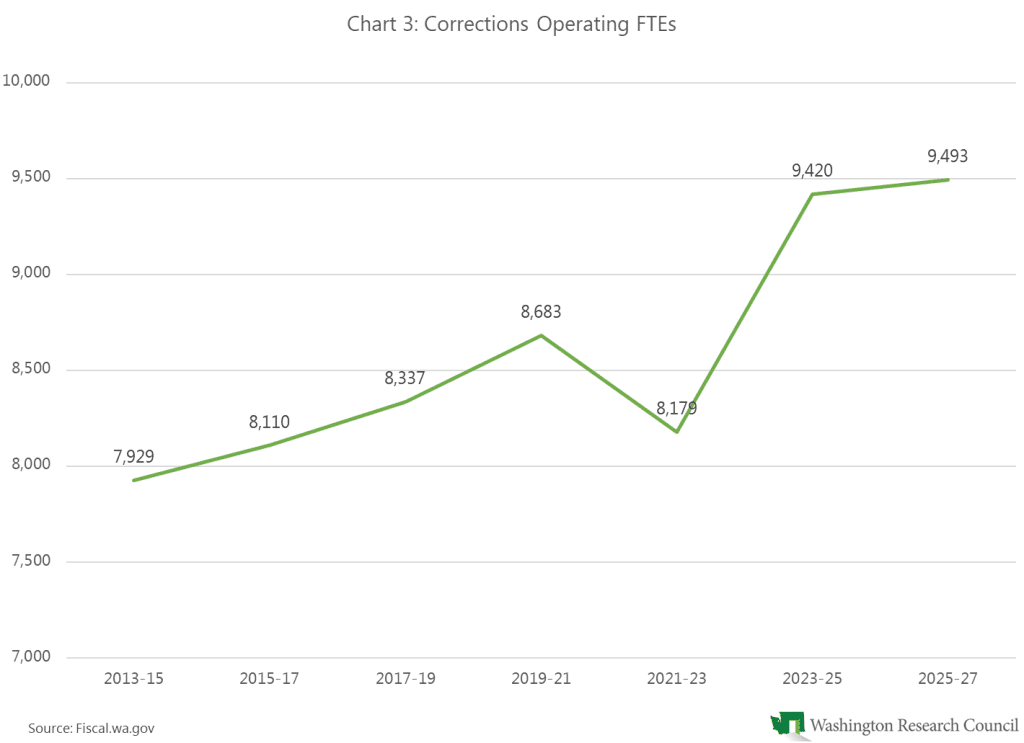
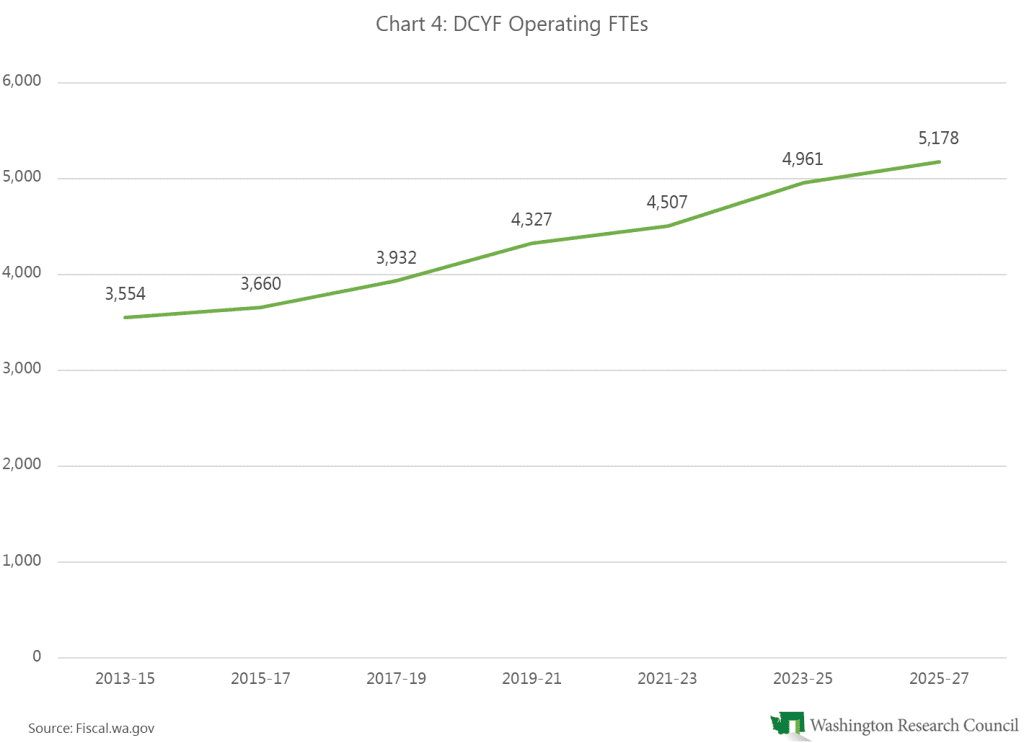
Charts 2, 3, and 4 show that the funded numbers of DSHS, Corrections, and DCYF employees will increase in 2025–27.

The State Library is part of the Secretary of State’s budget, so the fiscal data won’t show the number of State Library FTEs for either 2023–25 or 2025–27 until the end of the respective biennium. In 2021–23, the State Library had 58.9 FTEs.
Chart 5 shows that the number of FTEs is expected to decrease for the Department of Health. However, there was a very big increase in FTEs related to the pandemic in 2021–23. The number of FTEs in 2025–27 is still higher than the number in 2019–21.

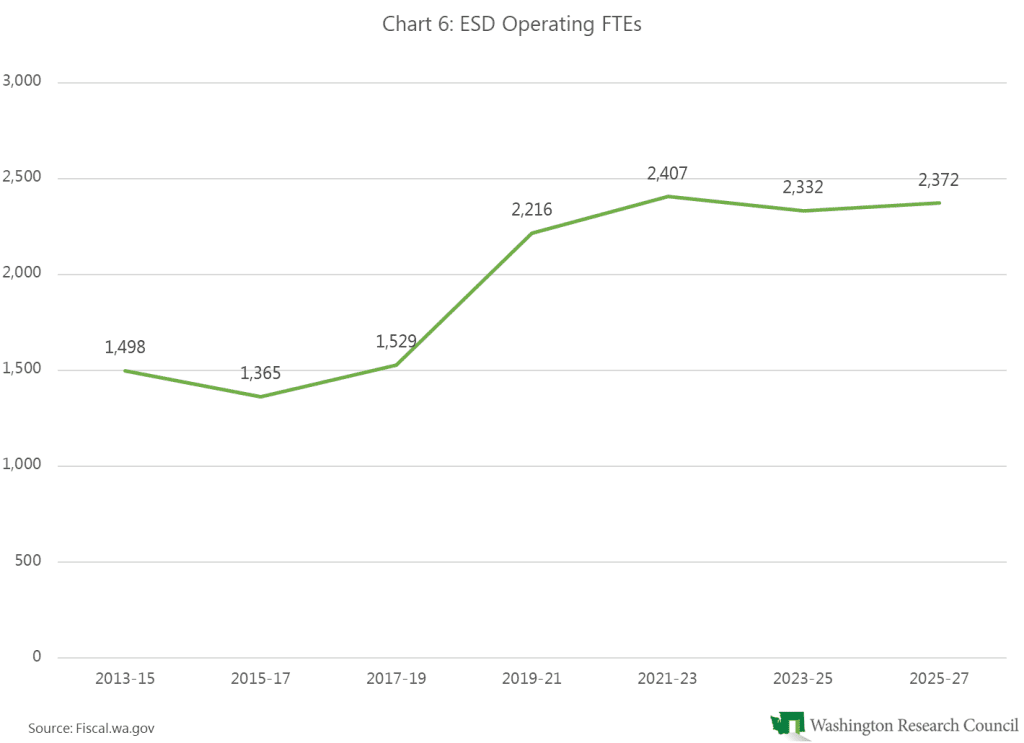
Finally, as shown in Chart 6, the number of FTEs for ESD increased substantially in 2019–21, when the paid family and medical leave program began and there were increased demands on the unemployment insurance program due to the pandemic.