
2:30 pm
December 19, 2024
For 2025–27, the estimated cost of continuing current services is expected to exceed current resources. As we showed in an October report, this is not a revenue shortfall—revenues are expected to grow by $5.040 billion in 2025–27 and by $5.414 billion in 2027–29. Instead, the estimated shortfall is the result of legislative spending choices over the past several years.
But how big is the problem? The answer depends on the assumptions made about revenue growth and spending. First, the four-year balanced budget statute allows the Legislature to assume that revenues in the second biennium will grow by 4.5% a year—even if the revenue forecast is lower than that. I’d argue that the Legislature should instead balance the budget over four years within the actual revenue forecast, as making this assumption was one of the contributors to the current problem. (Under the November revenue forecast, revenues are expected to grow by 3.6% in 2028 and by 3.5% in 2029. There will be another revenue forecast in the spring.)
Second, the maintenance level (the cost of continuing current services, adjusted for inflation and enrollment) for 2025–27 is not yet set in stone. The Office of Program Research (OPR) estimated earlier this month that the maintenance level (ML) change for 2025–27 is $4.377 billion. The Office of Financial Management (OFM) estimates (as part of Gov. Inslee’s budget proposal) that the ML change for 2025–27 is $4.936 billion. The ML figure will continue to be refined until a budget is enacted by the Legislature next year. (For example, there will be a new caseload forecast in the spring.)
Third, should the shortfall estimate include the cost of the collective bargaining agreements with employees? These are technically considered new policy, but they reflect the increased cost of employment.
The table below shows how the estimate of the shortfall changes depending on your assumptions. If you assume the OPR ML and actual forecasted revenues for 2027–29, the four-year shortfall is $7.7 billion. If you assume the OFM ML, the cost of the CBAs, and 4.5% revenue growth, the four-year shortfall is $11.1 billion.
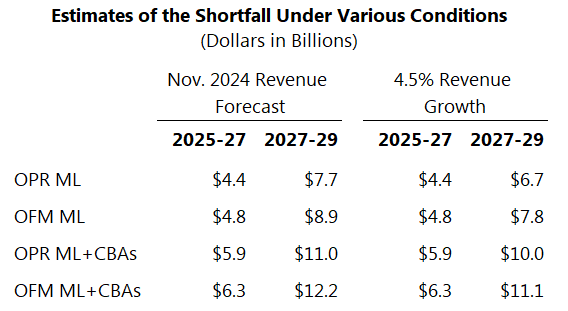
I think any of the numbers in the table are fair representations of the budget problem. (Note again, though, that the estimates are still preliminary.) The estimates based on the actual revenue forecast are more accurate, but the Legislature will likely take advantage of the 4.5% rule.
However, I do not think it’s fair to say that the shortfall is $16 billion, as Gov. Inslee did on Tuesday. According to OFM, that figure assumes current resources and the estimated maintenance level. But it also includes all the policy increases in the governor’s budget and none of his proposed policy reductions.
Categories: Budget.Tags: 2025-27