10:58 am
June 13, 2024
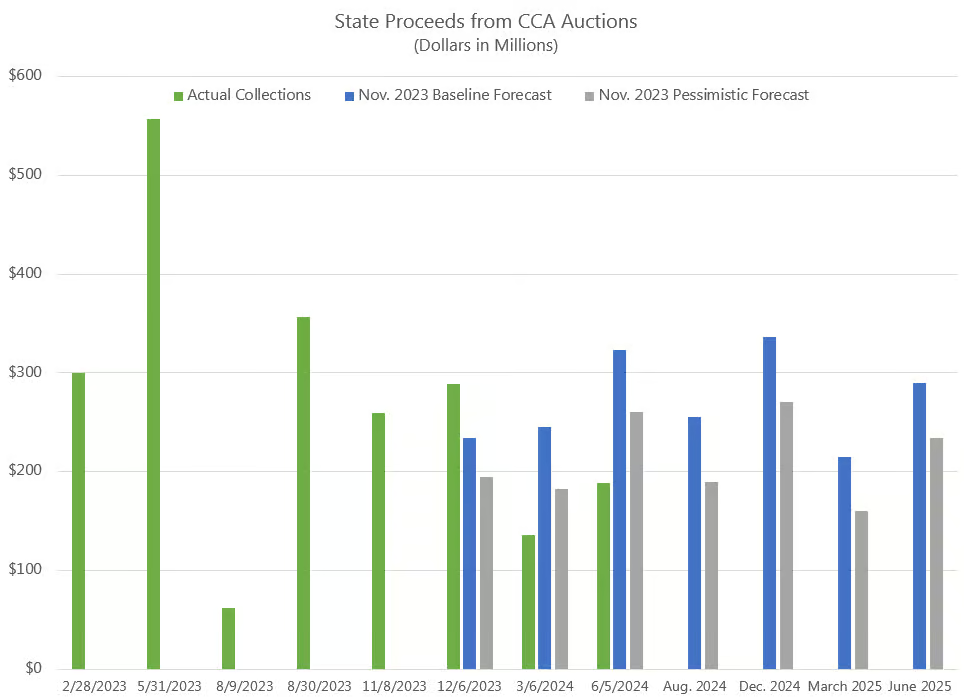
As Kriss wrote yesterday, the prices paid for carbon emission allowances at the June 5th auction were much lower than were paid on average last year. The state won’t release the official auction public proceeds report until July 3. That said, if my calculations are correct, state revenues from the June 5th auction are $189.0 million.
That’s $134.5 million less than was assumed in the Department of Ecology’s Nov. 2023 forecast of revenues from the auctions (and $71.4 million less than the pessimistic forecast).
This means that even if I-2117 is rejected—leaving the climate commitment act (CCA) in place—CCA appropriations for 2023–25 are $58.7 million higher than expected revenues. That calculation assumes that proceeds from the next auction in August will come in as expected by the Nov. 2023 forecast. But, as Kriss suggested yesterday, the auction results in March and June were likely low because of the uncertainty around the initiative. That effect will likely also impact the August auction. Of course, if I-2117 is rejected, auction proceeds could be higher than expected in the December 2024, March 2025, and June 2025 auctions, potentially counterbalancing the low proceeds pre-election. (Ecology is expected to have a new revenue forecast this month.) As it stands now, though, CCA appropriations are underwater.
Some of the CCA appropriations enacted this year will only become effective if I-2117 is rejected. Setting those aside, the appropriations that are effective now are $195.6 million higher than actual revenues plus the baseline assumption for the August auction (the last auction before the election).
Consequently, regardless of what happens with I-2117, legislators may need to reduce CCA appropriations to match actual revenues.