8:49 am
October 30, 2020
On Tuesday, the Office of Financial Management (OFM) made a new round of allocations from the state’s share of the federal Coronavirus Relief Fund (CRF). First, there is $8.9 million for Temporary Assistance for Needy Families caseload impacts from policy changes that waived time limit and participation requirements. Second, there is $5.1 million for the state’s match for the Food Assistance Program.
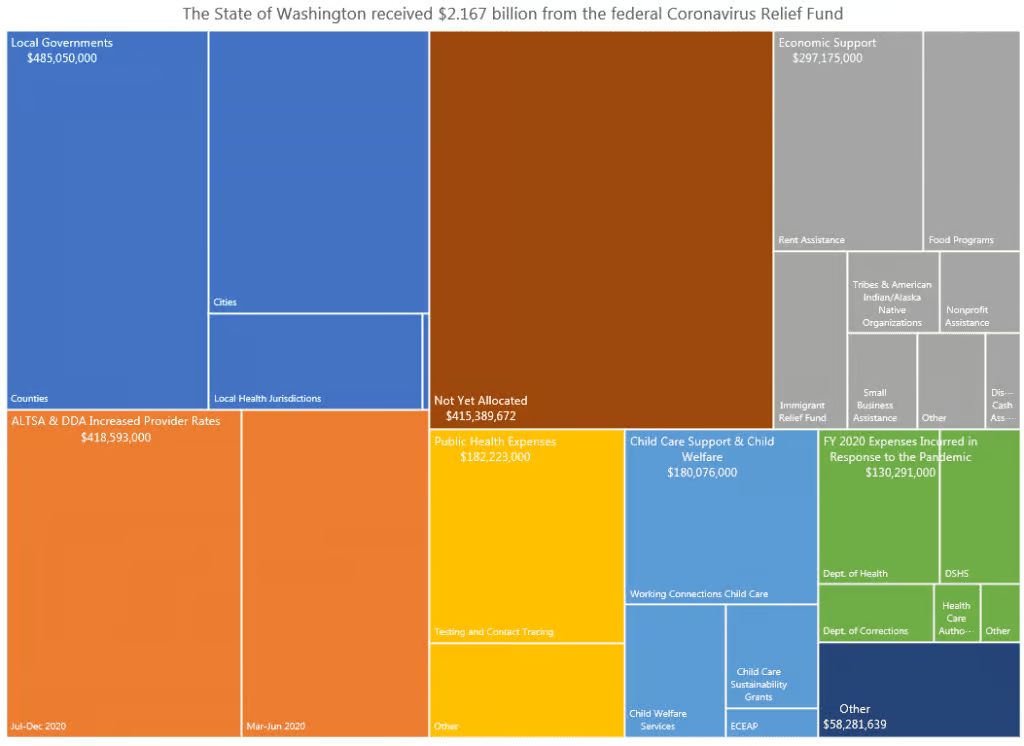
Third, there is $233.1 million for increased rates for residential and in-home providers through the Aging & Long-term Services Administration (ALTSA) and Developmental Disabilities Administration (DDA), for the period of July to December 2020.
This is a continuation of a policy to increase provider rates to account for their increased costs related to the pandemic (see here, for example). On Sept. 8, OFM had allocated $223.1 million for various purposes, including for ALTSA and DDA provider rates for March to June 2020. That letter did not specify how much went to which purpose. In an Oct. 1 presentation (posted by Jason Mercier of the Washington Policy Center), the Office of Program Research (OPR) showed the breakout of the Sept. 8 allocation. The provider rate increase for March to June cost $185.5 million. Together, the increased provider rates are the state’s second largest use of the CRF, after transfers to local governments.
Accounting for all publicly available information, the state has $415.4 million left of its share of the CRF. (Click on the chart below for the underlying data and more information.)
In the Oct. 1 presentation, OPR also noted that the state could use the CRF to backfill some portion of the $200 million withdrawal from the budget stabilization account in March. If that is done, it would improve the budget outlook.
Categories: Budget , Categories.Tags: CARES Act , COVID-19 , state action on COVID-19