3:18 pm
January 2, 2020
By law, the governor is required to propose a budget that balances within existing revenues (called the current law or “book 1” budget). Governors typically also propose alternative budgets that are based on increased revenues (“book 2” budgets)—these alternative budgets represent their preferred budgets.
Unusually, Gov. Inslee’s current law 2020 supplemental budget would appropriate more than his preferred budget, in terms of funds subject to the outlook (NGFO). NGFO appropriations would be $4.0 million higher in the current law proposal than in the preferred proposal, but appropriations from all funds would be $4.4 million lower in the current law proposal than in the preferred proposal. All the differences between the current law and preferred proposals occur in the Department of Fish and Wildlife (WDFW).
As Kriss noted, the governor’s preferred proposal does not include major tax increases. It does propose, however, an increase in hunting and fishing license fees. These fees would increase by about 15 percent. According to the Office of Financial Management, the proposal is the same as HB 1708 (introduced but not enacted last year). The proposal would increase revenues by $7.5 million a year (the revenues would largely go to the state wildlife account).
In the governor’s preferred budget proposal, contingent on adoption of the fee increases, funding for several WDFW programs would be maintained (using the state wildlife account) and funding for others would be shifted from the general fund–state (GFS) to the state wildlife account.
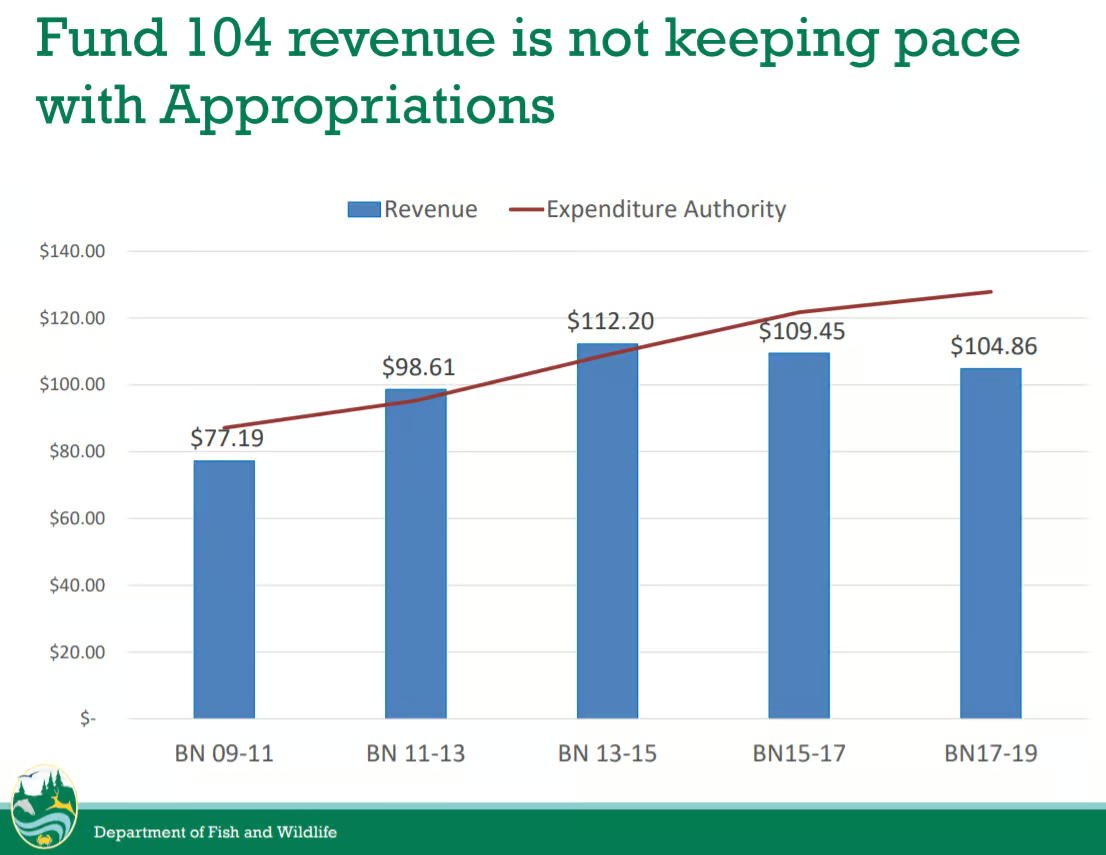
The state wildlife account is a major funding source for the WDFW, and there are concerns about a structural deficit in the account. The 2017–19 operating budget required the WDFW to “conduct a zero-based budget review.” (The report is here.) In November, the Senate Ways & Means Committee heard from staff that the state wildlife account “lacks sufficient funds to cover the costs authorized in the 2019–21 biennial budget,” despite the fact that the budget appropriated $24.2 million to WDFW from the GFS for operating budget support. The chart below is from a WDFW staff presentation to W&M (fund 104 is the state wildlife account).
Additionally, bills have been pre-filed in the House (HB 2238) and Senate (SB 6072) at the request of WDFW that would split the current state wildlife account into two separate accounts. The bills note that the zero-based budget review “identified a structural deficit in the current state wildlife account, which does not differentiate between restricted use revenues and nonrestricted revenues.”
The bills would create the “limited fish and wildlife account,” which would hold funds that must be used for specific purposes, and the “fish, wildlife, and conservation account,” which would hold non-restricted funds.
Categories: Budget , Categories.Tags: 2019-21