
11:40 am
August 14, 2020
On June 17th, Raj Chetty and his team at Opportunity Insights unveiled and began regularly updating a new data set documenting real-time economic statistics. Chart 1 displays one statistic, total consumer expenditures in Washington relative to January. It shows expenditures plummeting in mid-March before gradually recovering over the past several months.

Chart 2 focuses on consumer spending on groceries (shown in orange) and the restaurant and hotel sector (blue). Grocery spending spiked in March as panicked shoppers cleared shelves. Then, from April to the present, spending levels varied between 0 and 20 percent above the January baseline rate. Meanwhile, expenditures on restaurants and hotels plummeted in March. They then gradually rose for several months. Since February 25th, restaurant and hotel expenditures are down 49 percent relative to January, while spending on groceries is up 15 percent.
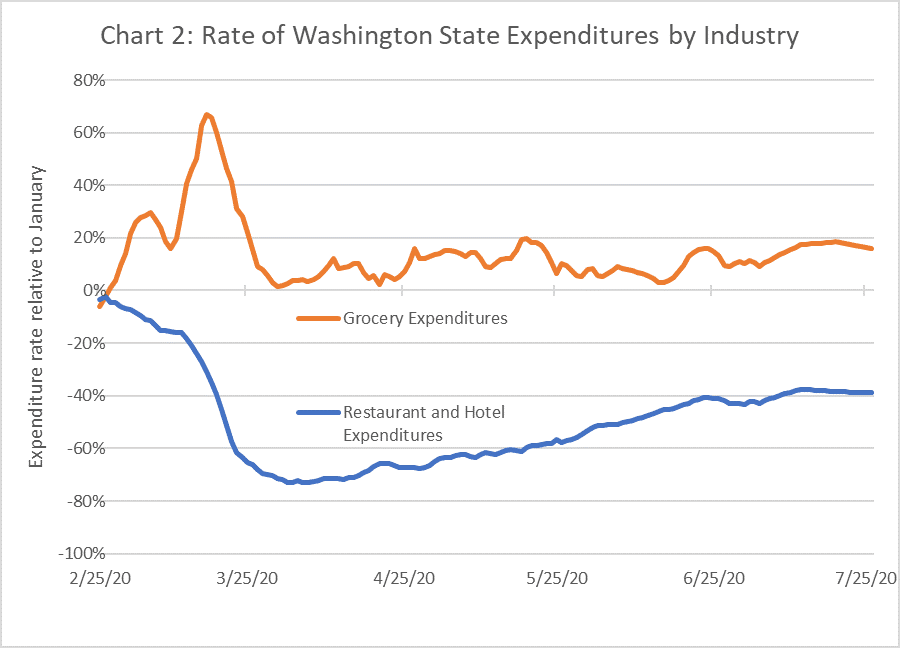
The decrease in spending on restaurants and hotels and the increase in spending on groceries will have implications for the state budget because restaurant and hotel consumption is subject to the sales tax, while most grocery expenditures are not. Historical tax data illustrate the extent to which decreases in restaurant and hotel spending could impact the state budget; in 2019 the state collected $1.02 billion and $248 million in sales taxes on restaurants and hotels, respectively. The impact of any reduction in sales tax revenue will be particularly significant given the current state budget situation. Based on the June revenue forecast, the Office of Program Research projects an unrestricted ending balance of negative $3.403 billion for funds subject to the outlook in 2019-21.
For more information on the real time-consumer expenditure data in this post, please refer to the paper “How Did COVID-19 and Stabilization Policies Affect Spending and Employment? A New Real-Time Economic Tracker Based on Private Sector Data.”
Daniel is a WRC intern.
Categories: Categories , Economy.