
1:15 pm
February 14, 2023
The current rates for Washington’s estate tax range from 10% to 20%. That top rate is tied with Hawaii for the highest state estate tax rate in the country. (The exclusion amount in Washington is just $2.2 million, compared to $5.5 million in Hawaii.)
HB 1795, which was heard by the House Finance Committee this morning, would increase Washington’s top estate tax rate to 40%. A very interesting fiscal note for the bill was released today, which I’ll discuss below.
Proposed Estate Tax Rates
HB 1795 is very similar to HB 1465, which was introduced in 2021 but not passed by either house. The table shows how the rates would change under HB 1795 compared to current law. (The new rate brackets would be the same as under HB 1465.) HB 1795 would reduce estate taxes for estates worth between $2.2 million and $2.7 million. It would increase estate taxes for estates worth more than $3.0 million. For example, a $10 million taxable estate would pay $370,000 more under HB 1795 than under current law. A $100 million taxable estate would pay $9.2 million more under HB 1795 than under current law. A $1 billion taxable estate would pay $144.2 million more under HB 1795 than under current law.
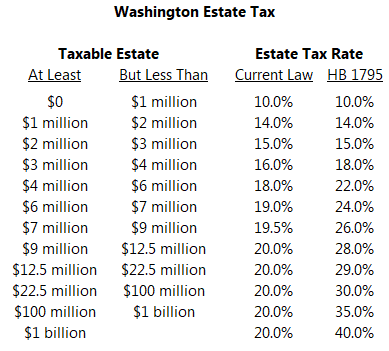
(Note that there appears to be a mistake in the text of HB 1795. The new estate tax table is shown in Sec. 2 of the bill. It shows the new tax rates and the accompanying new initial tax amounts for each bracket. However, it neglects to update the initial tax amount for taxable estates of at least $3 million up to $4 million. As written, this would result in a cliff where a taxable estate of $3,999,999 would owe $570,000 in estate tax and a taxable estate of $4,000,000 would owe $580,000 in estate tax. Under current law, both of these estates would owe $550,000.)
Exclusion from Tax
Meanwhile, currently $2.2 million may be excluded from the state estate tax. The exclusion amount is supposed to be adjusted annually for inflation, but it has not been adjusted since 2018 because the statute ties the inflationary adjustment to a now-defunct index. HB 1795 would address this problem by increasing the exclusion amount to $2.7 million (beginning with deaths occurring on or after Aug. 1, 2023) and tying the adjustment to the consumer price index (CPI) for the Seattle metropolitan area going forward (beginning with the estates of decedents dying in 2025).
Similarly, HB 1484, which was heard by Finance Feb. 9, would also increase the exclusion amount to $2.7 million and tie future adjustments to the Seattle area CPI. However, it would begin the inflation indexing in 2024. HB 1484 would not make any changes to the estate tax rates. The fiscal note estimates that HB 1484 would reduce estate tax revenues by $66.6 million in 2023–25 and by $166.7 million in 2025–27.

Treatment of Charitable Donations
A major difference between HB 1795 and HB 1465 is how each bill would treat charitable donations. Under current federal and state law, estates may deduct charitable donations from the estate tax owed. HB 1465 would have limited that ability: Estates would have been allowed to deduct just 75% of the first $100 million of charitable donations and just 25% of any amount over $100 million. As I wrote in 2021, this would have effectively taxed charities that would otherwise have received those donations.
HB 1795 restricts this limitation to donations to family foundations. The bill defines “family foundation” as a private foundation or a public charity, as described in Sec. 509 of the federal Internal Revenue Code. (Sec. 509(a) of the federal Internal Revenue Code defines a private foundation as any 501(c)(3) other than public charities, which are defined in Internal Revenue Code section 509(a)(1), (2), (3), and (4).) Additionally, the decedent must have transferred money or assets to the foundation or charity; the decedent or a family member must have served on the governing board in the past; and a family member or employee must currently serve on the governing board.
If a decedent’s charitable donations do not go to such a family foundation, it appears that they could be fully deducted from the Washington estate tax under HB 1795.
Other
Like HB 1465, HB 1795 would increase allowed deductions from tax for family-owned newspaper businesses.
HB 1795 would specify that estate tax returns need not be filed if the estate is not subject to tax and if the value of the estate less the value of the decedent’s family residence is less than the applicable exclusion amount.
Use of Funds
Currently, all estate tax collections are dedicated to the education legacy trust account (ELTA). Under HB 1795, the Department of Revenue (DOR) would be required to calculate (twice a year) the amount by which estate tax collections increased due to HB 1795 compared with the collections that would have come in under current law. The incremental amount would be deposited into a new progressive policy account.
The progressive policy account “may only be used to address intergenerational poverty.” Specifically, the bill states that it is the intent of the Legislature that in 2023–25 and 2025–27 the account should be used to implement recommendations from the WorkFirst poverty reduction oversight task force and the homeowner disparities work group.
The WorkFirst poverty reduction oversight task force was established in 2018 to oversee the development of a “five-year plan to reduce intergenerational poverty and promote self-sufficiency.” The plan developed by the Department of Social and Health Services includes eight strategies and various recommendations. (It is available in the materials from the Jan. 6, 2020 meeting.) The recommendations include, for example: “increase and preserve affordable housing,” “increase cash assistance and remove work requirements,” and “incorporate racial equity outcomes and measures into programs.” The most recent tracking tool for the plan is here.
The homeownership disparities work group was established in the 2021–23 budget. The work group’s final report includes 27 recommendations, including increasing state funding for affordable homeownership programs, increasing per-household limits on assistance awards, and funding government-backed loans to reduce need for large down payments.
Fiscal Impact
The fiscal note for HB 1795 estimates that the bill would increase revenues by $33.1 million in 2023–25, $59.3 million in 2025–27, and $41.3 million in 2027–29. The version of the fiscal note that is currently posted shows these amounts going to the ELTA but does not show the required transfer from the ELTA to the new progressive policy account (PPA). A revised fiscal note will show that the full revenue impact would be transferred from the ELTA to the PPA.
The bill attempts to siphon off the increased revenues from the new rate structure, while leaving the ELTA whole. But according to the fiscal note, the reduction in revenues from the inflation-adjusted exclusion amount is estimated to be larger than the increase in revenues from the new rate structure beginning in 2035. Because of the way the bill is written, this means that the PPA would no longer receive estate tax revenues at that point. (HB 1465 had also wanted to direct some of the new revenues to a new account, but it would have just taken 10% of all estate tax receipts rather than trying to calculate an incremental amount.)
Additionally, since the exclusion amount would be increasing, more estates would not have to file returns over time. If HB 1795 passes as written, it would be difficult if not impossible for DOR to be able to estimate how much would have been collected under current law compared to the new law—because they won’t know what estates would have been subject to the tax at the lower exclusion level.
Finally, it is important to note that the fiscal note does not assume changes in taxpayer behavior. Such a substantial change to the estate tax rate structure would surely lead individuals to adjust their estate planning.
Categories: Categories.