
11:52 am
September 7, 2023
The department of ecology today announced the results of its third regular auction of Cap-and-Invest Program allowances, which was held on August 30 (link). The settlement price for current (2023) vintage allowances was $63.03. This is up significantly from the 2023-vintage price at the May 31 auction, $56.01.
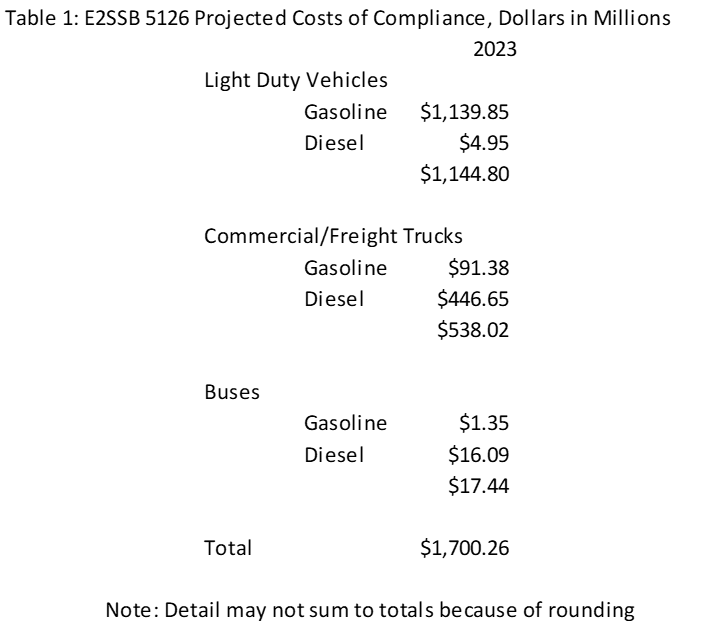
Table 1 contains my updated projections of the cost of compliance under SB 5126’s cap-and-invest system for on-road use of gasoline and diesel fuel in Washington state, by class of vehicle, based upon the settlement price from the department of ecology’s August 30 allowance auction. These compliance costs are projected costs only, and the ultimate cost to vehicle owners will be affected by the results of future allowance auctions as well as the competitive dynamics of the wholesale and retail transportation fuels markets.
How I calculated these numbers:
The Table 2 calculations begin with the state’s September 2022 Transportation Revenue Forecast (link), which provides forecasts of total consumption of gasoline and diesel fuel, in gallons, by fiscal year. I translate the fiscal year forecasts into calendar years by averaging overlapping fiscal years. I then allocate these fuel quantities across vehicle classes based on national forecasts of fuel use by vehicle class from the U.S. Energy Information Administration’s Annual Energy Outlook 2022 (link), assuming that each class’s share in Washington is equal to its nationwide share. The three classes are light duty vehicles (e.g. cars, pickup trucks and motorcycles), commercial and freight trucks, and buses.
To calculate the costs shown in Table 1, I multiply the forecasted quantities by the fuel-specific projected per gallon compliance costs shown in Table 2.
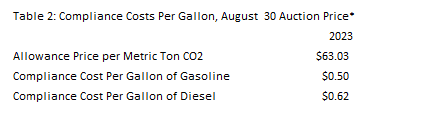
The first line in Table 2 shows the August auction allowance price per metric ton of CO2. (Prices determined at past and future auctions and in the secondary market for allowances will affect ultimate compliance costs for regulated entities. The most recent auction price is our best estimate of the average of these prices.) On the second and third lines, these metric-ton prices are translated into projected costs per gallon of gasoline and diesel using carbon dioxide emissions coefficients from the Energy Information Administration (link). I assume that gasoline consumed in Washington includes 10 percent ethanol, and that diesel fuel includes 4 percent biodiesel.
The estimates do not include any of the costs that the cap-and-trade system may impose on refinery operations.
Revised/corrected November 8, 2023
Categories: Economy , Energy & Natural Resources.